
Anúncios
Executive summary: cleaning remains one of Europe’s fastest-entry work sectors
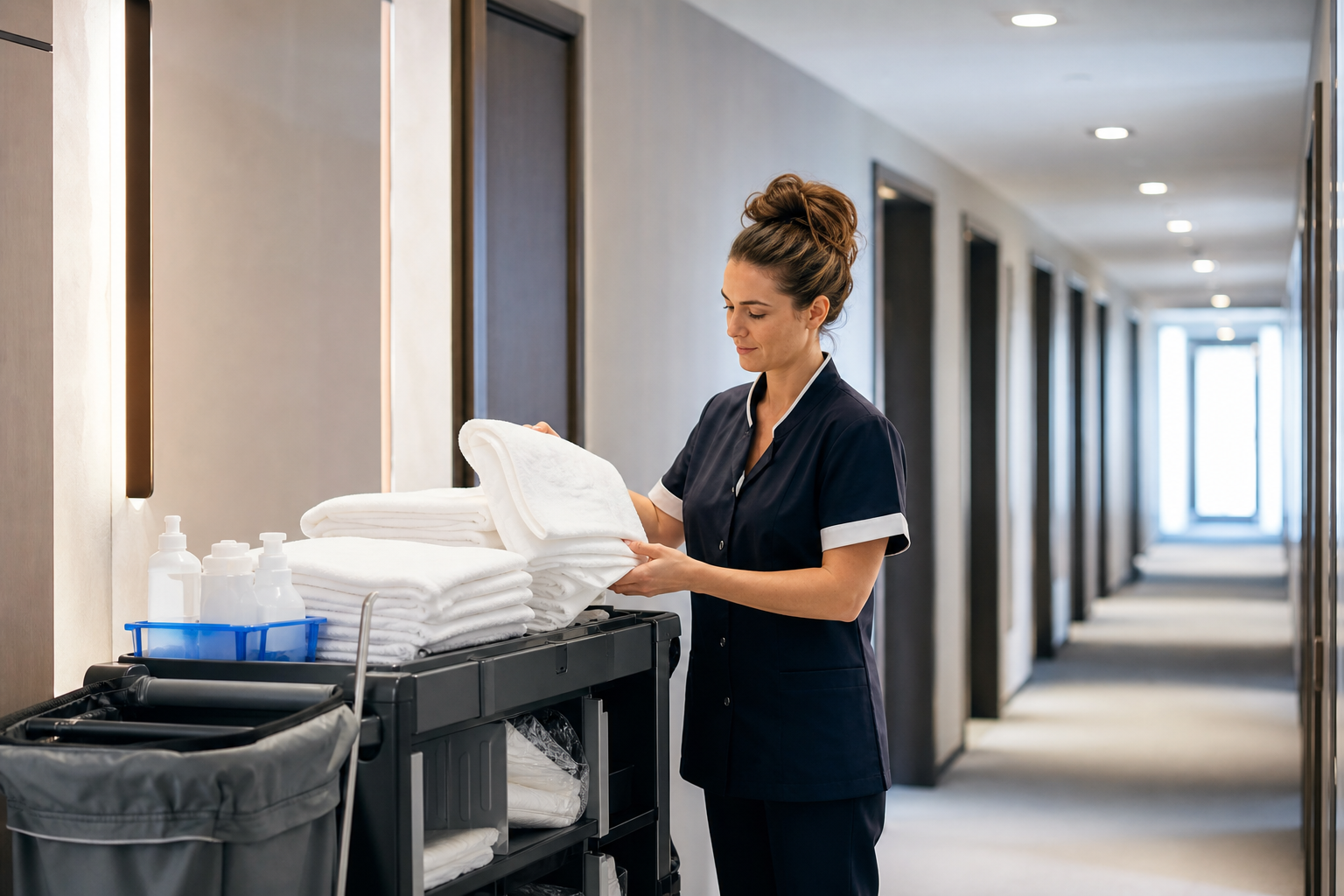
Cleaning is one of the few sectors across Europe where beginners can still enter quickly, earn legally from the first weeks, and build toward supervision or facilities work without a university degree. The smart path depends on choosing the right segment, understanding pay structures, and protecting yourself against weak self-employment setups.
Cleaning work is often underestimated because entry barriers are lower than in office careers. Yet the sector covers homes, hospitals, offices, factories, hotels, schools, transport, and specialist industrial sites with very different skill and pay profiles.
Across Europe, demand stays steady because cleanliness is not optional. Buildings must open, rooms must turn over, tenants move in and out, and regulated workplaces must meet hygiene and safety standards every day.
That constant need creates room for several career models. Some people want flexible side income, some want full-time agency work, and some want a long path toward team lead, contract manager, or facility manager roles.
This guide explains where beginners start, how rates differ across countries, when self-employment makes sense, how platform work fits in, and what protections matter before you accept your first clients or shifts.
Why cleaning services offer a realistic career start
Cleaning is practical because demand is broad, training time is short, and many employers hire for attitude and reliability before they ask for long experience. That makes the sector accessible to migrants, career changers, and people re-entering work.
It also offers multiple schedule models. You can find early-morning office rounds, daytime domestic work, hotel housekeeping blocks, evening commercial shifts, and industrial roles with structured rotation patterns.
Unlike trend-driven sectors, cleaning demand does not disappear when a social platform changes or a startup closes. Contracts may move between providers, but the underlying need for hygiene and presentation remains.
The downside is that the sector can hide poor conditions behind the idea that anyone can do it. Good employers train, protect, and schedule properly. Weak ones rely on pressure, unstable hours, and unclear status.
A cleaning career becomes attractive when you treat it as skilled operational work rather than as something temporary that does not deserve careful comparison.
Residential cleaning: flexible entry, trust-based growth
Residential cleaning includes regular home visits, deep cleans, move-in and move-out work, short-term-rental turnover, ironing support, and occasional post-renovation jobs. It is often the easiest segment to enter quickly.
The strongest asset in residential work is trust. Clients care about punctuality, communication, discretion, and consistent results more than about formal credentials in the first stage.
This segment works well for people who want daytime hours, repeat customers, and the option to build a private client base over time. It is less comfortable if you dislike working alone or traveling between homes.
Pricing can look attractive, especially in large cities, but unpaid travel, cancellations, and supply costs reduce real earnings if the setup is loose. That is why route planning and client quality matter heavily.
For many beginners, residential cleaning is the fastest way to start earning, learn standards, and decide whether to stay employed or gradually build independent work.
Commercial cleaning: the stable middle ground
Commercial cleaning covers offices, shops, schools, clinics, gyms, apartment common areas, and public-facing facilities. The work is usually more standardized than residential cleaning and often organized through contracts with companies.
This segment often suits beginners who want predictable routines and formal supervision. Equipment, products, and task lists are more likely to be supplied by the employer or contractor than in casual residential work.
Schedules can still be demanding because many sites must be cleaned before opening or after closing. Early mornings and evenings are common, but the weekly pattern is often more stable than gig-style domestic work.
Commercial roles can also provide a clearer promotion ladder. Team leader, site supervisor, quality checker, scheduler, and area manager roles often grow out of this environment rather than from isolated home-cleaning rounds.
If you want cleaning to become a longer operational career, commercial work is usually the most balanced place to build discipline, references, and management habits.
Industrial and specialized cleaning: harder entry, higher value
Industrial cleaning includes factories, production lines, warehouses, food-processing sites, transport depots, high-access cleaning, and environments where safety rules are strict and mistakes are expensive.
Beginners can enter this segment, but not always immediately. Employers often want stronger safety discipline, PPE compliance, machine awareness, and willingness to work around noise, chemicals, cold rooms, or unusual hours.
The physical and procedural demands are higher than in domestic work, yet the pay can also be better. Specialized tasks such as glass, façade, sanitation, or regulated-facility cleaning usually command stronger rates.
This is the segment where cleaning becomes visibly technical. The work is no longer only about appearance. It is about hygiene, hazard reduction, compliance, and production continuity.
If you want a route toward better pay without leaving the cleaning field entirely, specialized and industrial work is where the sector often becomes more defensible as a long-term career.
The physical reality of the job
Cleaning is real physical work. Repetition, standing, bending, lifting, pushing carts, handling linen, and moving quickly between tasks can wear down even fit beginners who underestimate the load.
That does not mean you need athlete-level strength. It means you need pacing, decent footwear, hydration, and a work setup that does not quietly destroy your body through bad technique or impossible staffing.
Good employers teach movement, chemical handling, sequencing, and injury prevention. Weak employers talk as if speed matters more than body preservation, which usually creates turnover and avoidable pain.
Before accepting a role, ask what the normal shift includes in square meters, number of rooms, number of sites, or equipment type. Those details explain the physical reality better than the title ever will.
Your body is part of your career capital in cleaning services. Protecting it early is not optional if you want to stay in the sector long enough to move up.
Skills that matter more than beginners expect
Attention to detail matters because missed corners, streaks, and forgotten touchpoints are what clients actually remember. Speed without finish quality rarely builds a strong reputation.
Time management is the next major skill. Cleaners who can sequence tasks, avoid backtracking, and adapt when something is dirtier than expected usually outperform people who simply rush harder.
Communication matters more than stereotypes suggest. You need to confirm access, report problems, explain delays, and sometimes reassure clients or supervisors about what was completed and what was not.
Basic product knowledge also separates stronger workers quickly. Knowing which surface needs which product, dilution, cloth, or tool saves time and prevents expensive damage.
These are learnable skills, not personality gifts. That is good news for beginners because it means the gap between average and valuable can close faster than in many white-collar sectors.
Certifications, training, and when they matter
Many beginner cleaning jobs do not require a formal certificate on day one. Employers often provide site-specific training for tasks, products, hygiene routines, and customer expectations during onboarding.
Training matters more when you move into hospitals, food environments, industrial sanitation, high-access work, or supervisory roles. In those settings, safety and compliance become part of the value you sell.
Even when certification is optional, short courses in chemical safety, infection control, COSHH-style handling, or floor-care equipment can make you more employable and easier to trust with premium work.
If you plan to become self-employed, training is also marketing. Clients may not understand every certificate, but they do respond to signs that you work methodically and safely.
The key is not collecting random credentials. It is getting the training that fits the cleaning segment you actually want to grow inside.
Typical rates across Europe: use country context, not one magic number
Rates vary by country, segment, employment model, and whether the figure is an employee wage or a self-employed client charge. Beginners get confused when they compare those categories as if they were the same thing.
Germany has one of the clearest official sector floors because building-cleaning minimums are set nationally, with interior and maintenance cleaning at 15 euros per hour in 2026 and glass or façade work higher still.
The Netherlands uses a statutory hourly minimum wage rather than a monthly one, with the adult minimum at 14.71 euros from January 2026 and 14.99 euros from July 2026. Actual cleaning rates can sit above that depending on the employer or collective agreement.
France, the UK, and the Nordics also differ sharply by structure. France uses the SMIC as a floor, the UK depends heavily on market and region, and Nordic countries rely more on collective agreements than a single national minimum.
Use the table below as orientation only. It helps you ask better questions, but it is never a substitute for the exact contract, city, and task scope in front of you.
| Country or region | Typical beginner cleaning rate | Common model | Important context |
|---|---|---|---|
| United Kingdom | £12 to £18 per hour, often about €14 to €21 | Agency, in-house, or self-employed domestic work | London and deep-clean jobs can sit much higher than small-town regular cleans |
| Germany | €15.00 to €18.40 per hour in many building-cleaning roles | Sector employment with official wage floors | Specialized glass and façade work pays above routine interior cleaning |
| France | €12.31 to €16.00 per hour in many entry paths | Employment based on SMIC floor or sector rules | Cleaning contractors and urban areas can lift rates above the legal minimum |
| Netherlands | €14.71 to €20.00 per hour | Employer or agency roles, some self-employed domestic work | Adult hourly minimum rose to €14.99 from July 2026 |
| Nordic countries | Often €18 to €25 per hour or more | Collective-agreement driven employment | No single national minimum wage in several Nordic markets, so agreement coverage matters |
Agency work versus self-employment: choose the trade-off consciously
Agency or in-house employment usually gives beginners the safest start because hours, payroll, supplies, and legal contributions are clearer. You trade some pricing freedom for more structure and less administrative burden.
Self-employment can raise hourly earnings later, especially in residential work, but it also transfers risk onto you. You must handle taxes, cancellations, insurance, client acquisition, and product costs yourself.
Beginners often chase the highest advertised hourly number without noticing that it assumes unpaid travel, no sick pay, no guaranteed bookings, and full personal responsibility for admin.
A sensible path is often to learn standards inside an employer-run system first, then move toward self-employment once you understand timing, pricing, route planning, and client retention properly.
Neither model is automatically better. The right choice depends on whether you need immediate stability or long-term margin and independence.
Platform-based gig cleaning: Helpling, Hassle-style marketplaces, and what to watch
Platform work can help beginners find clients faster because the app or website handles discovery, scheduling, and payment flow. In Germany, for example, Helpling still operates as a marketplace for self-employed service providers and advertises flexible cleaning work.
That convenience comes with trade-offs. Platform cleaners may be responsible for their own taxes, insurance, pricing strategy, and schedule gaps, even if the booking journey feels like a normal job at first glance.
The older Hassle model in the UK helped popularize online domestic cleaning marketplaces, and similar platform logic still shapes many gig-cleaning offers across Europe. The brand matters less than the employment structure behind it.
Before joining any platform, check fees, cancellation rules, review systems, liability coverage, and whether you are treated as an employee, contractor, or marketplace provider. Those labels change your risks immediately.
Platform cleaning works best as a controlled tool, not as blind freedom. If you understand the terms, it can help you build volume. If you do not, it can leave you busy but underprotected.
- Read who sets the price: you, the platform, or the client.
- Check whether late cancellations are compensated.
- Confirm whether liability insurance exists and when it applies.
- Ask how disputes, damage claims, and no-access visits are handled.
- Count unpaid travel time before deciding your minimum acceptable booking.
- Treat platform ratings as business infrastructure, not as a casual side detail.
- Know whether you can take repeat clients off-platform without penalties.
- Build an emergency savings buffer if your income depends on gig bookings.
Worker rights and basic protections
Cleaning workers need the same seriousness about rights as workers in any other field. Minimum pay, rest time, safe equipment, proper chemical handling, and documented employment terms are not optional luxuries.
The strongest protection usually comes from clear employment status, visible payslips, and employers who explain contributions and safety rules openly. Confusion is often the first sign that the setup is weaker than it should be.
If you are self-employed, protection does not disappear, but it changes form. Insurance, tax compliance, client contracts, and cancellation policy become part of your own operating discipline.
Migrant workers should be especially careful when housing, transport, and work all depend on one intermediary. That structure can create dependence even when the headline job looks legal.
A good cleaning job should make your position clearer over time. If each week adds more uncertainty around money, safety, or status, you are likely in the wrong arrangement.
Career progression: from cleaner to supervisor or facility manager
Cleaning can become a management career when you stay long enough to master standards, scheduling, quality control, and client communication. Many supervisors started exactly where beginners start now.
The first promotion steps often include key-holder responsibility, training new staff, checking rooms or sites, ordering supplies, and reporting quality issues. These tasks teach coordination before formal management titles appear.
From there, workers can move toward area supervision, contract management, hospitality housekeeping leadership, soft-services coordination, or broader facilities roles. The ladder is real, but it rewards consistency over flash.
If you want to move up, start acting like someone who notices systems, not only tasks. Learn why jobs are sequenced a certain way, how stock is controlled, and what clients actually complain about.
Cleaning careers rise when operational reliability becomes visible. Managers promote people who reduce friction, not just people who clean quickly.
Common red flags in beginner cleaning offers
Be careful when an employer or platform talks only about flexibility and never about the exact employment model. If nobody can explain whether you are employed, self-employed, or contractor-based, slow down immediately.
Another red flag is impossible productivity language, such as too many rooms, sites, or square meters for one shift without enough staff or equipment. In cleaning, unrealistic workload usually becomes unpaid stress.
Watch for hidden travel expectations. A role may advertise a good hourly rate, then quietly require long unpaid transfers between homes or sites that cut your real earnings sharply.
Beginners should also be wary of roles with no clear chemical training, no PPE guidance, or vague answers about damage responsibility. Safety confusion is not normal just because the work is practical.
Good cleaning companies can answer basic questions quickly. Weak ones rely on urgency, ambiguity, and the hope that you will accept first and understand later.
A practical 90-day plan for getting established
During the first month, choose your segment deliberately: residential, commercial, or industrial. That decision determines what clothing, transport, training, and schedule logic you will need from the start.
In the second month, learn your numbers. Count real travel time, supplies, fatigue, and hourly return instead of guessing. This is the point where many beginners discover which jobs only looked profitable on paper.
In the third month, improve one lever that raises your value, such as language, specialist training, client communication, or route efficiency. Small upgrades compound quickly in a task-based service career.
Keep written records of hours, products, incidents, and client feedback from day one. Whether you stay employed or become independent later, that habit gives you control over your own progress.
The best early result is not simply being busy. It is becoming dependable, profitable, and physically sustainable enough to stay in the sector on your own terms.
Investing in good equipment and insisting on safety training from the start makes day-to-day work easier, reduces accident risk, and positions you as a reliable professional. If an employer does not provide protective gear or safety briefings, raise the issue—this is a red flag in any sector, but especially in cleaning, where physical risks are part of the job.
| Job Type | Essential Equipment | Key Safety Focus |
|---|---|---|
| Residential | Vacuum, microfiber cloths, mop, mild detergents, gloves | Chemical safety, lifting safely, personal security in private homes |
| Commercial | Commercial-grade vacuum, floor buffer, warning signs, disinfectants, PPE | Slips/trips, handling cleaning machines, repetitive motion strain |
| Industrial | Heavy-duty machines, specialized solvents, respirators, hard hats | Hazardous material procedures, machine safety, confined space awareness |
Below is a compact comparison of typical starter equipment needs and safety priorities for three cleaning job types:
Safety risks in cleaning are real: chemical exposure, repetitive strain injuries, slips, and falls are among the most common hazards in the sector. While many European countries mandate safety training, adherence varies between employers. Don’t overlook basic protections such as gloves, non-slip shoes, and ergonomic practices—these can protect your health and open the door to longer, sustainable careers. For those working in specialized or industrial environments, advanced training in hazardous materials or biohazard cleanup may be necessary and is sometimes required by law.
Reliable cleaning work starts with the right tools and strong safety habits. For agency workers, most equipment and supplies (such as vacuums, mops, cleaning agents, gloves) are provided. Self-employed cleaners, however, must invest in their own gear and understand which products are suitable for different surfaces and environments. Using professional-grade supplies can save time and deliver a better result for clients, but they require proper handling.
Essential equipment and safety basics for beginners
- Ask for a sample weekly schedule before committing.
- Factor in commute time between job sites, especially in urban areas.
- Discuss flexibility with potential employers—some are more accommodating than others.
- Monitor your physical and mental fatigue, and adjust your workload when needed.
For anyone considering this path, it’s wise to realistically assess your familial or personal responsibilities. Many cleaners find that early shifts allow them to finish work before most other professions have even started, freeing up afternoons. However, split shifts or back-to-back bookings with travel time in between can significantly eat into personal time. Before accepting a contract, clarify expected hours and peak busy periods to prevent burnout and maintain stability.
Flexibility tends to be higher in small-scale residential jobs or self-employed arrangements, where cleaners can accept or decline clients according to personal availability. However, with agencies and larger employers, schedules are more fixed, and overtime is sometimes required to handle last-minute requests or special projects. Some countries also set strict limits on work hours for safety and well-being, but enforcement can be uneven—especially for informal roles.
Cleaning services offer a range of work schedules, but the reality of work-life balance depends greatly on the setting and contract type. Residential cleaners, for example, often work during daytime hours or early evenings, accommodating clients’ daily routines. Commercial and industrial contracts may require early mornings, late evenings, or even overnight shifts—especially in large office buildings, hospitals, or factories that need to be cleaned outside regular business hours.
Work-life balance realities in cleaning jobs
Editorial Disclaimer
This article provides general editorial information about cleaning careers across Europe. Pay, legal status, visa rules, collective agreements, self-employment obligations, and safety requirements vary by country and can change, so confirm the exact rules that apply to your location and work model before accepting employment or offering services independently.